 2 EP
2 EPEpisodes
Transcript
Episode 1 · Built to Impress — Structure and Voyage
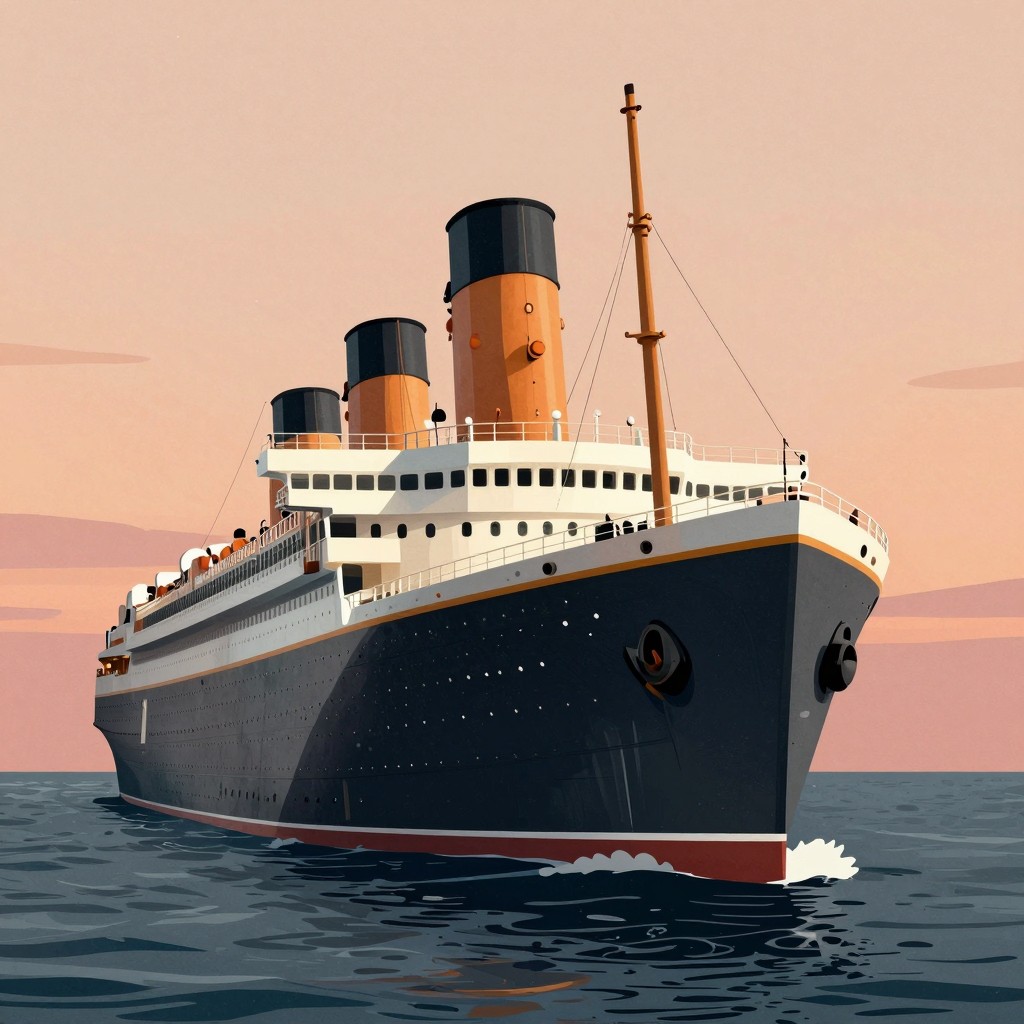
Maya: Before the iceberg, there was a ship built to make scale feel safe, Titanic's keel was laid at Harland and Wolff in Belfast on March 31, 1909, and she was launched on May 31, 1911 Ruth: And the records make that scale plain, 882.5 feet long, 92.5 feet wide, 46,329 gross tons, but big is not evidence of safety Maya: Right, triple screw propulsion drove her, and the design included 16 watertight compartments, designed to close automatically if water rose above a certain height Ruth: Which sounds reassuring, until you slow down over the wording, watertight compartments are a safety feature, not a guarantee Maya: Exactly, sixteen compartments tells us subdivision existed, it does not, by itself, show that every possible breach could be contained, that is the limit we have to examine Ruth: And embarkation gives us another scale check, on April 10, 1912, Titanic left Southampton for New York with 2,227 passengers and crew aboard Maya: Before she cleared Southampton, there was a near collision with SS New York, caused by suction from Titanic's propellers, a clue to the forces around a ship this large Ruth: So the maiden voyage is context, not explanation, but the crisis began with a newly launched giant, and thousands of people depending on its systems Maya: On April 14, at 11 40 pm, traveling at 20.5 knots, Titanic struck an iceberg on the starboard bow Ruth: Next time, we follow what that collision did to the design Maya: Thanks for joining us, we will see you below the surface
Episode 2 · Impact, Breakup, and Aftermath
Ruth: Last time, “Built to Impress, Structure and Voyage.” And now the unnerving question: after 11:40 PM, how does a ship this large become a wreck in two hours and forty minutes? Maya: Start with the clock. Titanic struck the iceberg at 11:40 PM on April 14. The damage let seawater enter the forward hull. Then came progressive flooding. As water rose through damaged compartments, it reached the next spaces. Not one instant plunge... a worsening geometry problem. Ruth: And the primary record lets us test that. Survivor testimony describes a long, confused evacuation, while wireless distress logs show Titanic was still calling for help. So, she remained afloat, but her margin was shrinking. Maya: Exactly. There were 20 lifeboats, with capacity for about 1,178 people. That is an engineering number with a human consequence: evacuation capacity was limited before the final structural failure began. Ruth: Then accounts diverge. Some survivors thought the ship went down intact. Others reported a break. Maya: Which is why the wreck matters. Discovered in 1985 at about 12,500 feet, it confirmed Titanic had broken apart. The hull failed near the double bottom, breaking from the bottom up. At 2:20 AM on April 15, Titanic sank. Ruth: Testimony gives us the lived sequence, the wireless record fixes the emergency, and the wreck tests the physics. Maya: And the aftermath changed maritime safety: more lifeboat requirements, and 24-hour radio watches. Ruth: Next time, we follow the consequences. Maya: Good night.