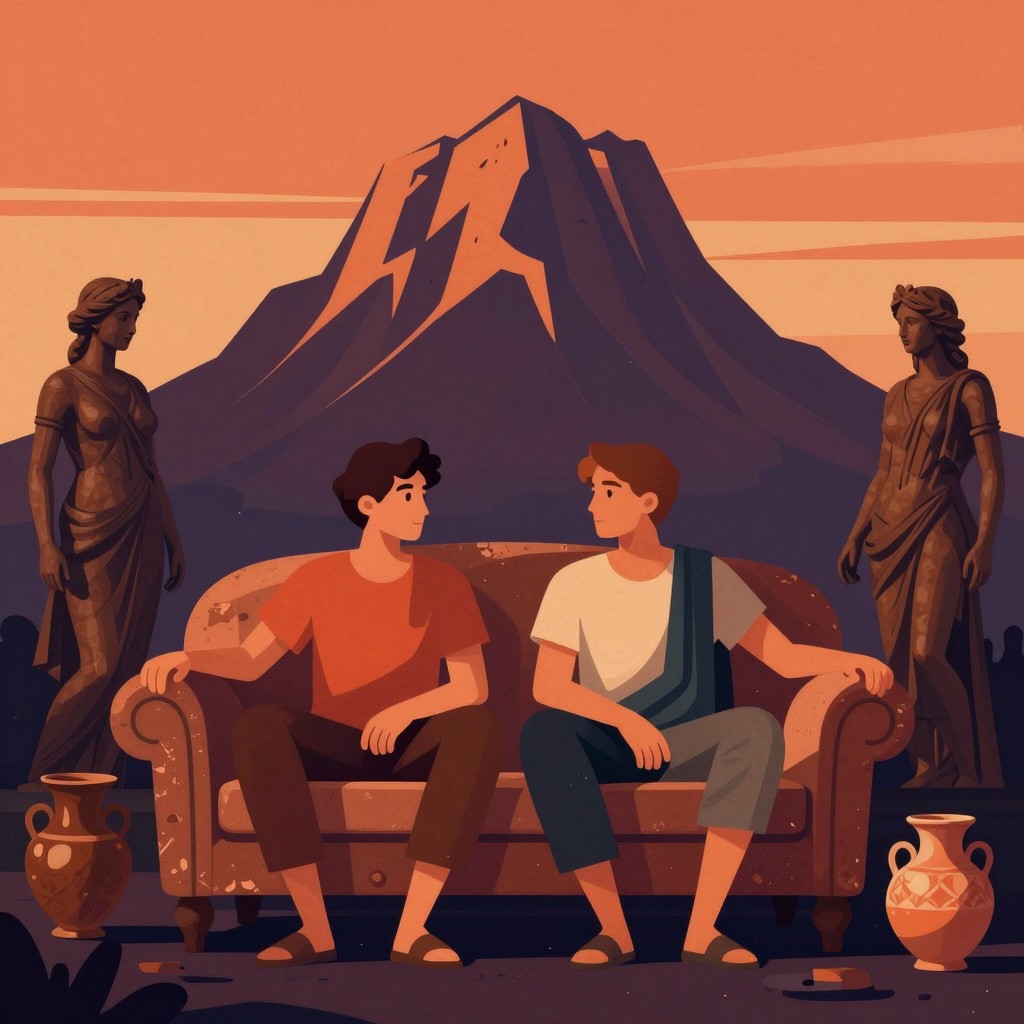
 3 EP
3 EPEpisodes
Transcript
Episode 1 · How the Gods Began
Daphne: Before Zeus had thunder, before Olympus had a throne room, there was Chaos, a vast, yawning void. Not messy bedroom chaos, Leon, more like, nothing has started yet chaos. Leon: Important distinction. The universe was not late for work. Daphne: From that emptiness came Gaia, the Earth, solid and fertile and wonderfully determined to get things moving. Then came Uranus, the Sky, stretching over her. Together, they brought forth the Titans, enormous early powers of the world. Leon: And, as Greek mythology often does, the family immediately became a problem. Daphne: Oh, instantly. One Titan, Cronus, overthrows Uranus and rules in his place. But Cronus is warned that one of his own children will overthrow him, so he swallows them whole. Leon: A truly terrible parenting strategy, even by divine standards. Daphne: His wife Rhea saves their youngest, Zeus, who grows up, returns, and helps free his swallowed siblings. Then comes the Titanomachy, the great war between the Titans and Zeus’s rising generation. Leon: A cosmic regime change, basically. The old powers versus the new gods. Daphne: And the new gods win. Zeus and his fellow Olympians, the familiar divine family of Olympus, take charge of sky, sea, wisdom, love, war, and all the very human chaos of being immortal. Leon: Though versions differ, that big shape remains, the world begins, power changes hands, and nobody in this family communicates normally. Daphne: Next time, we’ll settle onto Olympus itself. Bring a snack, and perhaps a lightning rod.
Episode 2 · Prometheus, Pandora, and the Heroes
Daphne: Last time, from Chaos to Olympus, Zeus had barely sat down before somebody nicked the fireplace. Leon: A very Greek opening move. Prometheus, a Titan and famously the Forethinker, steals fire for humans. Not a candle. Civilization’s terrifying little upgrade. Daphne: Right? I picture him slipping through Olympus with an ember, all, “Don’t mind me.” Zeus is furious. He chains Prometheus to a Caucasian mountain, where an eagle eats his liver every day... and it grows back. Cozy myth, absolutely not. Leon: Divine punishment tends to lack proportion. Fire means skill and independence, so the story asks whether human cleverness is a gift, or a line you’re not meant to cross. Daphne: And Zeus’s answer arrives as Pandora, fashioned from clay by Hephaestus, with gifts from the gods. She opens a jar, well, not originally a box, and out fly pain, disease, suffering, old age... the weather system of being human. Hope stays inside. Leon: Which is wonderfully ambiguous. Is hope saved for us, or shut away? Either way, the Golden Age is over. And then, uh, humans keep testing limits in hero stories. Daphne: Exactly. Heracles grunts through Twelve Labors, Perseus faces Medusa, and Achilles burns bright in the legendary Trojan War, shaped by Homeric storytelling. Then the Greeks win with the Horse, because apparently heroism includes committed carpentry. Leon: A tactical masterpiece. Ethically... a bit slippery. Daphne: These myths give suffering a cause, cleverness a cost, and gods who make family drama everyone’s problem. Next time, we’ll curl up with the monsters... if you dare. Leon: I dare. Provisionally.
Episode 3 · Why These Myths Still Stick
Daphne: Last time, with “Prometheus, Pandora, and the Heroes,” we left everybody carrying fire, hope, and, frankly, a rather alarming amount of trouble. And today I keep thinking, why do these old stories still feel like they know us? Leon: Because humans remain spectacularly vulnerable to a bad idea with excellent branding. Daphne: Ha, yes. Picture it. Someone reaches for gold, just one shining proof they can have more. Their fingers close, the cup gleams, the bread gleams, maybe the hand reaching back at them... gold. Suddenly abundance is a cage. Leon: The Midas-shaped warning label, basically. Daphne: Exactly. Then somewhere else, a person runs from a prophecy, choosing every turn, every road, and finds those choices tightening the knot. Oedipus is awful because fate feels real, but so does the decision to keep going. Leon: And Achilles gives us the other dread, that even the dazzling hero may have one vulnerable point. We call it an Achilles heel now, which is very efficient emotional shorthand. Daphne: These myths don’t say, “Behave, or else,” neatly. They ask what power does to you, whether wanting more can hollow you out, how much control anyone really has. Leon: Which is why writers, artists, and filmmakers keep borrowing them. Myth is handy allegory, a familiar shape for ambition, grief, war, family mess. Daphne: And retellings keep changing the angle, giving Pandora more voice, questioning heroes, moving Olympus into a school hallway or a spaceship. Leon: The old plots survive because the questions survive. Daphne: Big gods, painfully human problems. Leon: A decent reason to keep the sofa warm. Daphne: Thanks for sitting with us.