 1 EP
1 EPEpisodes
Transcript
Episode 1 · Being an Octopus: Brains, Arms, and Surprise
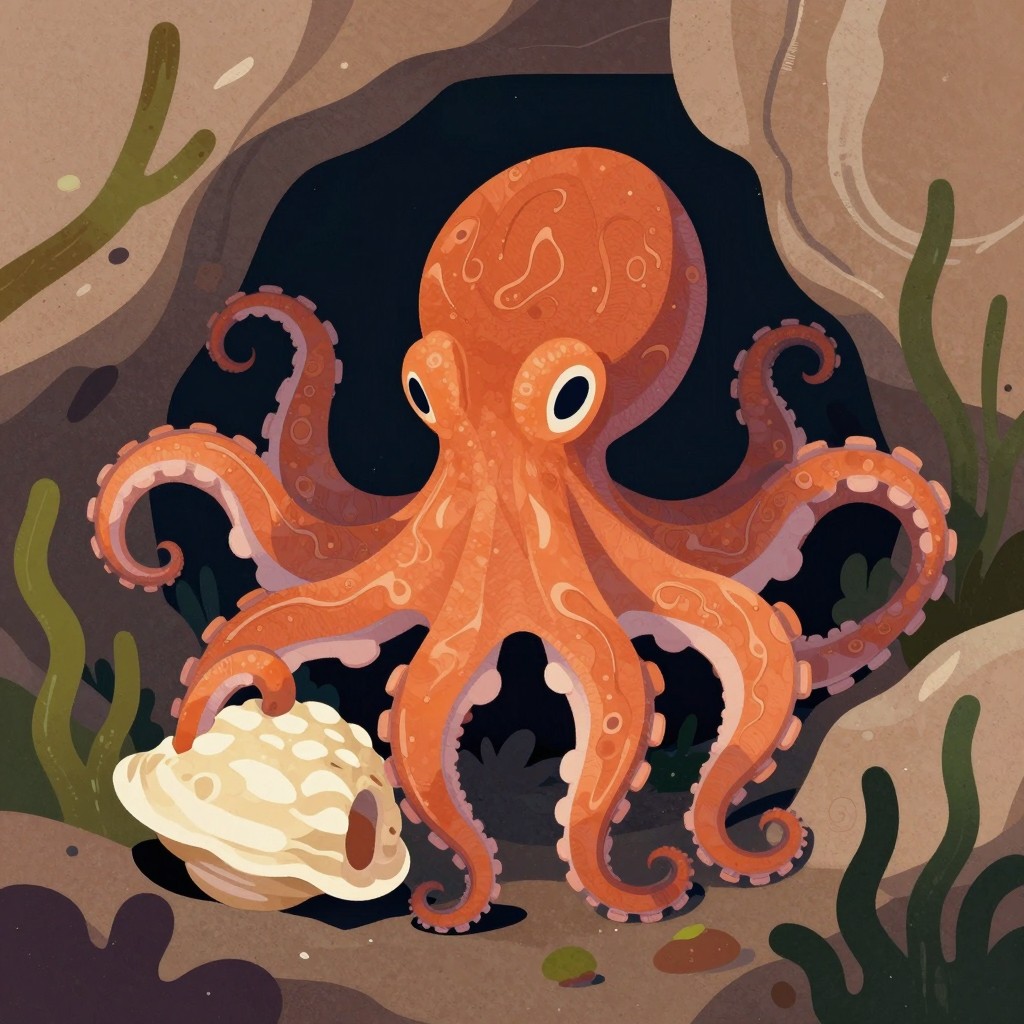
Enzo: Picture an octopus wrapping its arms around a jar, working at the lid, while its skin flashes into the colors and texture of the nearby reef. It looks like a tiny underwater magician. Arlo: Or, frankly, a very suspicious roommate who has figured out the snack cupboard. Enzo: Exactly. But that raises a bigger question. When we call an octopus intelligent, what do we actually mean? Arlo: Because “intelligent” can quietly mean, “It did a thing I couldn’t do with eight limbs and a wet body.” Enzo: A fair concern. Intelligence isn’t one single trait. It can involve learning, memory, problem-solving, self-control, social reasoning, flexibility. An animal may be strong in some of those and limited in others. Arlo: So today is not, “Are octopuses basically people in scuba gear?” Enzo: Definitely not. It’s, “What kind of intelligence helps an octopus be an octopus?” And the first clue is that its nervous system is organized very differently from ours. Arlo: Here comes the famous bit, where every arm has a brain? Enzo: Close, but that phrase is misleading. Octopus arms contain extensive neural circuits, and a substantial share of the animal’s neurons are in those arms. But each arm is not a separate little octopus with its own life plans. Arlo: Eight tiny coworkers, all ignoring the manager? Enzo: More like a director with eight remarkably capable crews. The central brain sets broader goals, things like, “Explore that crevice,” or, “Pull this object closer.” Then each arm can handle a lot of immediate sensory and movement detail locally. Arlo: Which makes sense, because an octopus arm is not like my arm. Mine has a few obvious joints. Theirs can bend, stretch, shorten, twist, and apparently become a new kind of noodle whenever required. Enzo: Right. Trying to centrally calculate every muscle movement in eight soft, flexible arms would be an enormous control problem. Local processing lightens that load. Arlo: Okay, give me the movie version. Enzo: Imagine an octopus hunting along a rocky seabed. One arm slips into a narrow crevice. Arlo: The central brain says, “Arm Three, investigate.” Enzo: More or less. The suckers on that arm are sensing by touch and chemical cues, almost tasting as they explore. The arm finds a rough edge, adjusts its grip, bends around it, and probes farther. Arlo: And headquarters is not issuing a detailed memo saying, “Sucker 47, rotate slightly left.” Enzo: Exactly. The arm can respond locally while remaining part of one coordinated animal. That’s distributed control, not eight independent brains. Arlo: That alone scrambles my mental picture of intelligence. It’s not just a smart brain commanding a dumb body. Enzo: Yes. The body is helping solve the problem. There’s a term from robotics, morphological computation. It sounds forbidding, but the idea is simple: the physical shape and material of a body can do some of the work that otherwise needs calculation. Arlo: So a soft arm naturally conforms to a surface instead of first solving a geometry exam. Enzo: Perfect. Its flexibility is not merely a challenge for the nervous system. It’s also an advantage. Arlo: All right, impressive body design. But what about the evidence for actual learning and flexible behavior? Enzo: The strongest evidence is associative learning in lab settings. Octopuses can learn to distinguish shapes, textures, and visual cues. With repeated experience, they change behavior based on rewards, unpleasant outcomes, and what has worked before. Arlo: That’s a solid “experience changes future choices.” Enzo: Yes. And they can manipulate objects, including jars, plugs, and latches. But performance varies by species, by individual, by motivation, and by the exact experiment. One dramatic escape story is a clue, not a complete explanation of what happened in the animal’s mind. Arlo: So, “octopus opened jar” does not automatically equal, “octopus planned a heist with a tiny blueprint.” Enzo: Precisely. Human-like planning remains uncertain. Complex behavior can come from specialized neural mechanisms, flexible exploration, memory, persistence, or several of those together. Arlo: What about hunting in the wild? Because probing crevices feels pretty tactical. Enzo: It is good evidence of flexibility. Different octopuses may probe with their arms, envelop coral with webs of skin, or use jets of water to disturb prey. These are context-sensitive tactics, showing they’re not simply running one rigid routine. Arlo: And camouflage, which is still the showstopper. Enzo: Rapid camouflage is genuinely remarkable. Specialized skin organs can change color, brightness, and texture dynamically. The octopus integrates visual information with motor control to match a background, break up its outline, imitate local features, or suddenly create a high-contrast display. Arlo: Though, important asterisk, we shouldn’t assume every skin pattern is a little emotional tweet. Enzo: Exactly. We still have open questions about whether particular patterns communicate intentions or internal states, versus immediate reactions. Arlo: And then there’s the coconut situation. Enzo: Coconut octopuses have been observed carrying shell halves and later assembling them as shelter. That is often called tool use, or more cautiously, tool-like shelter use, because the material is carried for future deployment. Arlo: Which is at least a very strong argument for “I may need this later.” Enzo: It suggests delayed utility, yes. But it does not, by itself, settle every question about planning. Arlo: So why did this odd sort of intelligence evolve? Enzo: The short version is: a soft-bodied predator in a complicated world had a lot to manage. Without an ancestral hard shell for protection, octopuses relied more on camouflage, hiding, escape, exploration, and tactical hunting. Reefs and crevices reward learning what is where, and a soft body with eight sensing arms rewards versatile control. Arlo: Intelligence not as an abstract puzzle champion, but as survival equipment. Enzo: Exactly. An octopus is a reminder that intelligence may not have one destination. It can be embodied, distributed, exploratory, and built for a body unlike ours. Arlo: Eight arms, hundreds of curious suckers, one very busy director. Enzo: And a useful question for the rest of us: when another animal solves a problem differently, are we seeing less intelligence, or simply a different kind? Arlo: That’s all for today. Stay curious, and maybe don’t underestimate the creature quietly inspecting the jar.