 3 EP
3 EPEpisodes
Transcript
Episode 1 · Aksum: The Highland Power with a Script
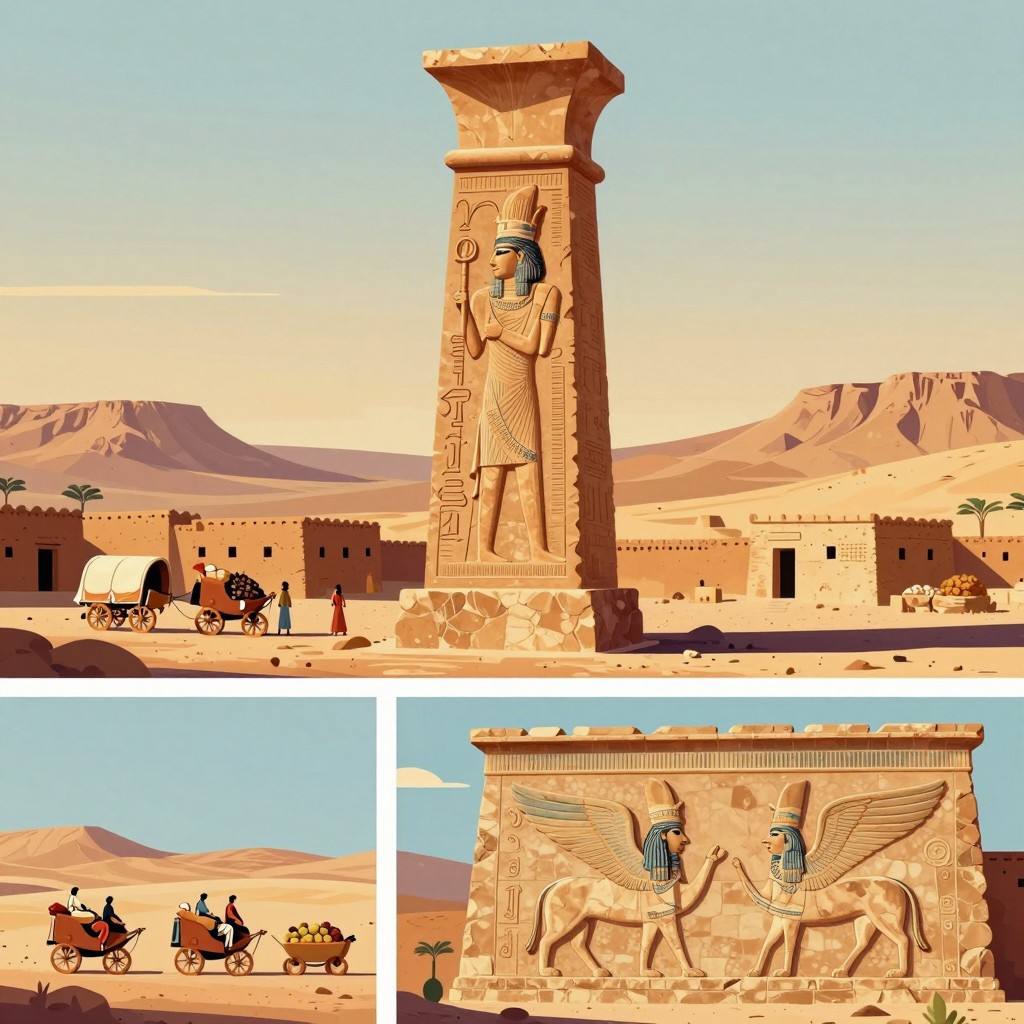
Amara: Here’s the thesis for episode one: Aksum was a highland African power that made itself visible... in stone, in coins, and in script, while connecting the Red Sea to the Roman Mediterranean and the Indian Ocean. Tariq: Which is already a useful correction, right? Because if your mental map of the ancient world is Rome, Greece, Persia, China... Aksum can feel like it arrives late in the story. Amara: It should not. Aksum flourished roughly from the 1st to the 7th century CE, centered in the northern Ethiopian highlands and Eritrea. Its influence extended into parts of what are now Djibouti, Sudan, Yemen, and Saudi Arabia. Tariq: And we’re not calling it powerful just because later traditions remembered it that way. Amara: Exactly. We have royal inscriptions, written in Ge'ez script; monumental stelae; coinage in gold, silver, and bronze; and archaeological remains including palace foundations. Those are material signs of organized rule, wealth, and royal authority. Tariq: The stelae are the visual knockout punch. These were carved stone pillars, some up to 33 meters tall. Amara: Yes. They served as royal tombs and symbols of power. Imagine the political message: this kingdom could quarry, carve, move, and raise enormous stone monuments. Tariq: State capacity, made impossible to ignore. Amara: Precisely. And Aksum’s power was not confined to the highlands. Its key port was Adulis, on the Red Sea. Through that network moved ivory, gold, incense, spices, glass, and textiles. Tariq: So Aksum sat on a route linking Roman consumers, Red Sea merchants, and the Indian Ocean world. Amara: That is the broad picture. And in the 3rd century CE, the Persian prophet Mani listed Aksum among the world’s four great powers, alongside Rome, Persia, and China. Tariq: That’s a remarkable contemporary frame. Not “an interesting regional kingdom.” One of the big powers. Amara: It is strong evidence of how Aksum could be perceived beyond its own borders, yes. Tariq: Then comes King Ezana, and the religious shift. Amara: In the 320s to 350s CE, Ezana adopted Christianity as the state religion, making Aksum one of the first nations to do so. That transformation matters because Aksum’s religious legacy endures in the Ethiopian Orthodox Tewahedo Church. Tariq: And its legacy is also national, not just archaeological. The script, the monuments, the Christian tradition... these remain part of Ethiopian identity. Amara: Right. Aksum later declined across the 7th and 8th centuries. Shifts in Red Sea trade, environmental degradation, and possibly plague all likely contributed. But “decline” should not mean disappearance. Tariq: Because the evidence is still there: coins, inscriptions, foundations, towering stone... a state telling us it existed. Amara: And telling us, quite deliberately, that it mattered. Tariq: Next time, another empire history class skipped. Thanks for listening. Amara: See you then.
Episode 2 · Kanem–Bornu: Lake Chad’s Long-lived Empire
Amara: Last time, we began looking beyond the usual imperial map. Today, picture Lake Chad, and a state that lasted, in changing forms, from around the 8th century to 1893. Kanem, Bornu was a long-lived Central African empire whose power, trade, and adaptation are visible in chronicles, oral traditions, and material remains. Tariq: And Lake Chad is the key image here, right? Because this is not just a kingdom with a lake nearby. Its story begins on the eastern shores of Lake Chad, in Kanem. Amara: Exactly. Around the 8th century, Kanem emerged there. The Duguwa dynasty established a capital called Njimi. Then, in the 11th century, the Sayfawa dynasty converted to Islam, linking the state more closely to wider religious and commercial worlds. Tariq: Which raises the practical question, what made this powerful? A capital and a dynasty are one thing. What gave Kanem real reach? Amara: Trade, in a very concrete sense. Under Mai Dunama II Dibalemi, around 1221 to 1259, the empire expanded and controlled key trans-Saharan trade routes. Sources connect that network to exports including salt, ivory, slaves, and animal products. Tariq: So, careful wording, we should not imagine trade as some vague prosperity machine. Control of routes meant access to valuable goods moving across the Sahara. Amara: Right. And that is why the evidence matters. Chronicles preserve political histories and rulers. Arabic accounts help show Kanem, Bornu’s place in wider exchange networks. Oral traditions preserve long memories of authority and identity. Archaeological finds add material evidence of the societies behind those accounts. Tariq: Different kinds of evidence, different strengths... and together they make the empire harder to dismiss as a name on a map. Amara: Precisely. But its durability did not mean stability. In the 14th century, internal conflict and pressure from the Bilala contributed to the loss of Kanem. Under Mai Umar I Idrismi, the empire relocated west of Lake Chad, to Bornu. Tariq: That relocation is the story, isn’t it? Not simply collapse, but adaptation. The state loses its old center and survives by rebuilding somewhere else. Amara: Yes. In the 15th century, Mai Ali I Gaji stabilized the state and established Ngazargamu as a new capital. Later, under Mai Idris Aluma, around 1571 to 1603, Bornu reached its zenith through military reforms and the promotion of Islam through jihads. Tariq: Then comes the long decline, beginning in the 17th century, before Rabih az-Zubayr’s invasion ended the empire in 1893, just before European colonization reshaped the region. Amara: And still, Kanem, Bornu’s influence endures in Kanuri people and culture. Its importance is not only its remarkable length, but its ability to change without disappearing. Tariq: Next time, we follow another empire that made power look very different. Until then, thanks for listening. Amara: See you next time.
Episode 3 · Neo‑Assyria: The Near East’s First World Empire
Amara: Last time, in “Kanem, Bornu: Lake Chad’s Long-lived Empire,” we followed endurance across centuries. Today, picture a palace wall at Nineveh, crowded with carved scenes of imperial power. Tariq: And, uh, not just power for show. Neo-Assyria was built to move commands, tribute, soldiers, and information across a huge area. Amara: Exactly. Our thesis is that Neo-Assyria, from 911 to 609 BCE, was not simply a violent conqueror. It was a tightly organized empire, and we can see that organization in royal inscriptions, palace reliefs, and administrative archives. Tariq: “First world empire” gets used a lot. What makes that more than a dramatic label? Amara: It is often regarded that way because of its territorial reach and influence. At its peak, it spanned Mesopotamia, the Levant, Egypt, Anatolia, and parts of Persia and Arabia. That is an enormous political system for this period. Tariq: So, not one city bullying its neighbors, but a structure connecting very different regions. Amara: Right. The Neo-Assyrian period is traditionally dated from Adad-nirari II, who reigned from 911 to 891 BCE. Over time, Assyria developed centralized rule from capitals including Kalhu, or Nimrud, Assur, Nineveh, Harran, and Dur-Sharrukin, also called Khorsabad. Tariq: But how do we know this was centralized in practice, rather than kings just claiming they controlled everything? Amara: That is where the evidence types matter. Royal inscriptions and palace reliefs proclaim centralized imperial rule and organized provincial control. Those are royal sources, so we should recognize their purpose, they project authority. Tariq: A palace relief is not exactly an impartial spreadsheet. Amara: Precisely. But administrative tablets from palace archives give us another angle. They record imperial logistics and tribute systems. Conquered provinces were organized into districts, paying fixed tribute and providing military contingents. Tariq: That is the key shift, isn’t it? Conquest becomes a repeatable system. Not, “We won once,” but, “Now this district owes specific resources and troops.” Amara: Yes. Think of it as an imperial operating system, though, um, one enforced by coercion. The army was among the first to establish a standing army, and it used advanced siege tactics alongside psychological warfare. Tariq: Which the reliefs make very visible, but also very deliberate. They are telling subjects and rivals, “Resistance has consequences.” Amara: Exactly. The inscriptions state royal claims, the reliefs visualize them, and the tablets show the machinery behind them. Together, those sources make the case much stronger than any one source alone. Tariq: And the influence lasted beyond Assyria itself, especially in monumental palaces and detailed bas-reliefs. Amara: Yes. Assyrian art and architecture significantly influenced later empires. Yet its system was not permanent. After Ashurbanipal died in 627 BCE, the empire began to disintegrate, and it collapsed in 609 BCE. Tariq: A sharp reminder that scale is not stability. Amara: And that empires are built not only through battles, but through records, districts, supply, and administration. Tariq: That is our three-episode corrective, really. Look past the familiar map, then ask, “What does the evidence actually show?” Amara: Thanks for listening.